
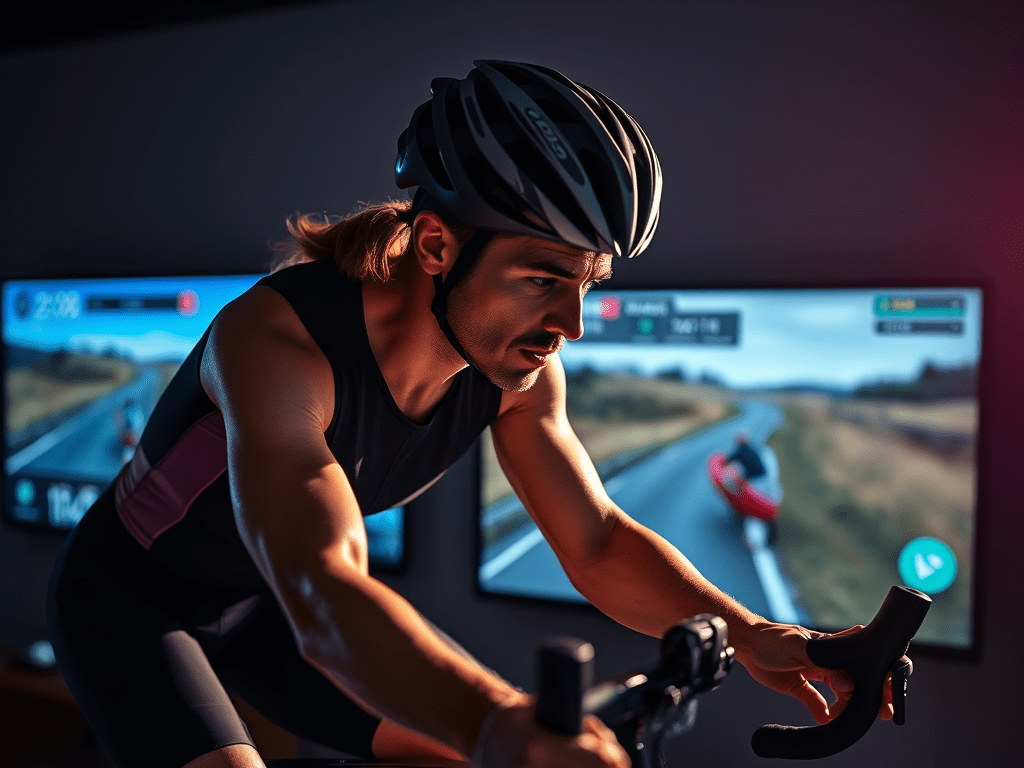
Remember the old days of indoor cycling? The clunky “turbo trainer,” the deafening roar, staring at a garage wall willing the minutes to pass. That monotonous drudgery is, thankfully, a relic of the past. Welcome to the indoor cycling renaissance, where the once-dreaded “pain cave” has transformed into a high-tech training hub, capable of delivering incredibly effective, engaging, and data-rich workouts.
For the endurance cyclist, the smart trainer has become an indispensable ally. It’s the secret weapon for consistent, structured training when bad weather rages, daylight dwindles, or life simply gets too busy for that long outdoor session. It’s where you precisely hone your fitness for that big event. Today, we’re diving into a three-way battle between titans of the smart trainer world: the ever-popular Wahoo KICKR, the feature-laden Tacx NEO series, and the robust Saris H3. Which of these powerhouses provides the best platform for your indoor endurance cycling ambitions?
This choice directly impacts your training. Smart trainers are a cornerstone for Time Management, allowing focused workouts anytime. They aid Injury Prevention by offering a controlled, lower-impact environment to perfect form. They provide a consistent setting for dialing in your Fueling strategies, and they are paramount for Peaking, enabling you to precisely execute those critical structured workouts.
Why Smart Trainers Are a Game-Changer for Endurance Cyclists
If you’re still on the fence, here’s why a smart trainer is transformative:
- ERG Mode Excellence: This is magic. Set your target wattage (e.g., for an interval), and the trainer automatically adjusts resistance to keep you there, regardless of your cadence. Perfect for nailing structured workouts.
- Simulation & Immersion: Feel the burn of virtual Alpe d’Huez or the cobbles of Flanders. Smart trainers replicate real-world gradients and integrate seamlessly with platforms like Zwift, TrainerRoad, and Rouvy, making indoor rides far more engaging.
- Data-Driven Progress: Get accurate, consistent measurement of your power output, cadence, and speed – crucial data for tracking fitness gains and tailoring your training.
- Consistency & Control: No traffic lights, no headwinds (unless you have a KICKR Headwind!), no surprise downpours. Just pure, uninterrupted, quality training.
The Contenders: Unpacking the Tech & Features
Let’s meet our three heavyweights. We’re focusing on their current direct-drive iterations, which offer the best experience by connecting directly to your bike’s drivetrain.
- The Ecosystem King: Wahoo KICKR (e.g., KICKR V6 / KICKR MOVE)
- Key Specs: Renowned for its heavy physical flywheel providing realistic inertia. Boasts +/-1% power accuracy, simulates gradients up to 20%, and offers robust ANT+ FE-C, Bluetooth, and now WiFi connectivity for more stable connections.
- Signature Features: AXIS feet allow side-to-side motion for a more natural feel. The premium KICKR MOVE integrates fore-aft motion. Seamless integration with the KICKR CLIMB (gradient simulator) and HEADWIND (smart fan). Features auto-calibration.
- Price Range: KICKR V6 approx. $1,300; KICKR MOVE approx. $1,600.
- The Innovation Leader: Tacx NEO Series (e.g., NEO 2T Smart / NEO 3M)
- Key Specs: Unique virtual flywheel design. Claims +/-1% power accuracy, simulates up to 25% gradients, and offers all standard connectivity.
- Signature Features: Famous for its “Road Feel” (simulating cobbles, gravel), descent simulation (trainer speeds up downhill), and pedal stroke analysis. Can operate without external power. The top-tier NEO 3M adds built-in, multi-directional motion plates for an incredibly immersive ride.
- Price Range: NEO 2T Smart approx. $1,400; NEO 3M approx. $2,000.
- The Quiet Workhorse: Saris H3 Direct Drive Smart Trainer
- Key Specs: Features a substantial physical flywheel. Claims +/-2% power accuracy, simulates 20% gradients and 2000 watts. Standard ANT+ FE-C and Bluetooth.
- Signature Features: Praised for its exceptionally quiet operation and solid, durable build. Often seen as a no-fuss, high-performance option.
- Price Range: H3 typically around $800-$1,000 (often subject to good discounts).
The Virtual Battleground: Head-to-Head Performance & User Experience
- Ride Feel & Realism:
- KICKR: The heavy flywheel provides a smooth, road-like inertia, especially noticeable when accelerating or free-wheeling. AXIS feet (and KICKR MOVE’s integrated motion) add a welcome degree of natural movement.
- Tacx NEO: The virtual flywheel is incredibly responsive. The unique Road Feel and Descent Simulation features add layers of realism unmatched by physical flywheels. The NEO 3M’s integrated motion plates take this to another level.
- Saris H3: Offers a very smooth and consistent ride feel thanks to its well-balanced flywheel, punching above its price point in this regard.
- Noise Levels (The “Apartment Dweller” Test): The Tacx NEO series generally wears the crown for the quietest operation, with the virtual flywheel producing minimal mechanical noise – mostly just your drivetrain. The Saris H3 is also impressively hushed, a very close contender. The KICKR, while not loud, does generate slightly more drivetrain and flywheel hum due to its physical flywheel mechanism. All are vastly quieter than older wheel-on trainers.
- Power Accuracy & ERG Mode Performance: All three claim excellent power accuracy (+/-1% for KICKR/NEO, +/-2% for H3), and in real-world use, they deliver reliable and consistent numbers crucial for structured training. ERG mode performance is smooth across the board, with quick resistance changes, though some users find the KICKR and NEO slightly faster to lock onto power targets than the H3.
- Gradient & Resistance Simulation: Each can simulate steep climbs (20-25%) and high wattage (2000-2200W+), more than enough for even the strongest cyclists. The realism of holding resistance on a 15% virtual climb is impressively punishing on all.
- Stability & Build Quality: All three are robustly built and offer stable platforms for hard sprints and out-of-the-saddle efforts. The KICKR and H3 have adjustable legs for uneven floors. The NEO has a distinctive, stable design.
- App Compatibility & Connectivity: No issues here. All connect seamlessly via ANT+ FE-C and Bluetooth Smart to popular training platforms like Zwift, TrainerRoad, Wahoo SYSTM, FulGaz, and more. The KICKR’s newer WiFi connectivity can offer a more robust connection in some environments.
- Setup, Calibration, & Maintenance: Direct-drive trainers require removing your rear wheel. Setup is generally straightforward for all. The KICKR boasts auto-calibration. Tacx NEOs typically don’t require calibration. The Saris H3 may need occasional spin-down calibration via its app.
- Price vs. Premium Features: This is where choices diverge. The H3 offers core high-end performance at a lower price. The KICKR sits in the premium middle, especially with its ecosystem. The NEO series, particularly the 3M, is the top-tier feature king.
Crowning the Indoor Champion: Which Trainer Best Suits Your Needs?
- Wahoo KICKR / KICKR MOVE:
- Pros: Excellent road-like ride feel, robust Wahoo ecosystem (CLIMB, HEADWIND), WiFi, KICKR MOVE adds fantastic integrated motion.
- Cons: Premium pricing; its physical flywheel isn’t as silent as the NEO’s virtual one.
- Verdict: A superb, highly refined all-rounder. Ideal for athletes who love Wahoo’s ecosystem, prioritize a traditional heavy flywheel feel, and might opt for the MOVE’s elegant motion solution.
- Tacx NEO Series (2T / 3M):
- Pros: Often the quietest; unique Road Feel and Descent Simulation; can be used without power; pedal stroke analysis. The NEO 3M adds best-in-class integrated motion.
- Cons: Typically the highest price point; the virtual flywheel feel is distinct and some may prefer a physical one.
- Verdict: The ultimate choice for tech-savvy cyclists seeking the absolute quietest ride, most immersive features, and cutting-edge motion (with the 3M). If your budget stretches, it’s hard to beat.
- Saris H3:
- Pros: Excellent power accuracy and ride feel for its price point; very quiet; robust and reliable. Often considered the best value in the high-end direct-drive market.
- Cons: Fewer “bells and whistles” than KICKR or NEO. Saris has faced some market uncertainties, though the H3 product itself is well-regarded.
- Verdict: A fantastic option for riders prioritizing core smart training performance (accuracy, quietness, good ride feel) and value over the very latest extra features.
Making Your Choice: Consider your budget first. Then, how important are extra features like integrated motion or road feel versus a slightly quieter or more ecosystem-friendly experience?
Conclusion: Conquer the Indoors, Dominate the Outdoors
A quality smart trainer is more than just an exercise machine; it’s a powerful training partner that transforms indoor cycling from a necessary evil into a targeted, engaging, and highly effective component of your endurance journey. While the Wahoo KICKR, Tacx NEO series, and Saris H3 each have their nuances, any one of them will provide a fantastic platform to help you build fitness, manage your time effectively, and ultimately, crush your outdoor goals.
Which smart trainer is the heart of your pain cave? Share your experiences, what you love (or perhaps don’t love) about it, and your favorite indoor training app in the comments below!
Discover more from ABC Endurance
Subscribe to get the latest posts sent to your email.
