
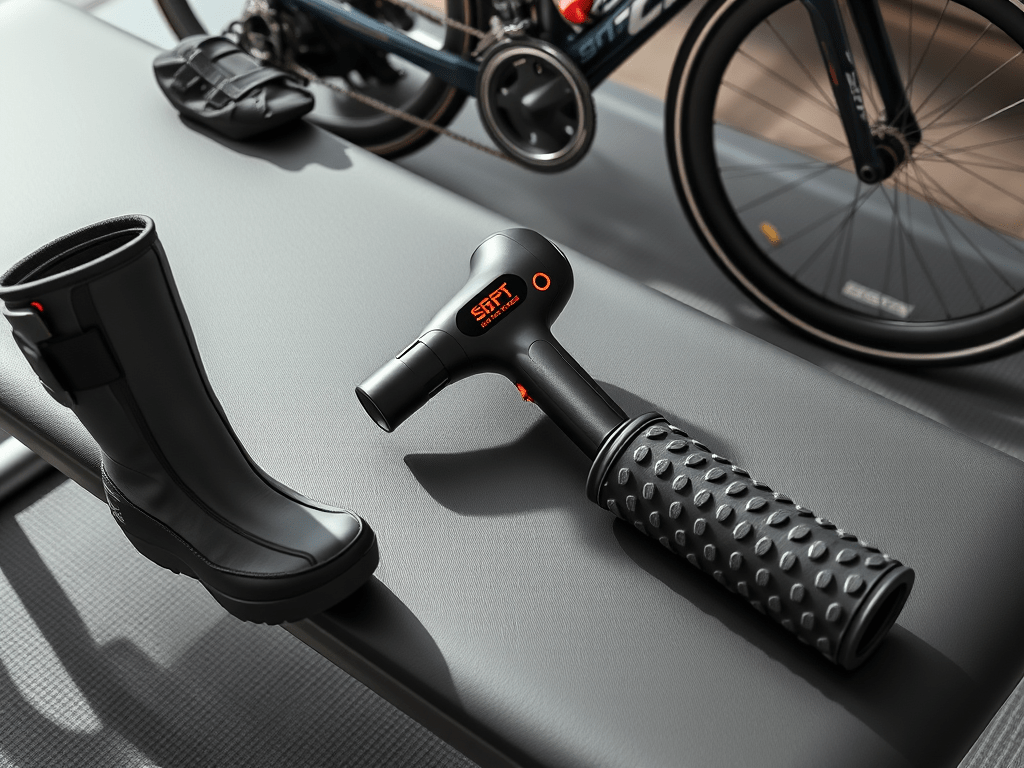
You’ve done it. The epic century ride, the grueling interval session, the long, soul-satisfying day exploring new roads. Your legs are humming with that glorious ache of effort well spent – a badge of honor for any endurance cyclist. But as the euphoria fades, a new mission begins: recovery. You know the drill – rehydrate, refuel with a good protein-carb mix, maybe stretch a little. But in today’s quest for peak performance and rapid bounce-back, is that enough? The modern cyclist’s arsenal is expanding, and a new wave of high-tech (and some cleverly evolved low-tech) tools promise to accelerate recovery, banish soreness, and get you back in the saddle feeling fresher, faster.
Here at ABC Endurance, we understand that smart recovery is non-negotiable. It’s the bedrock of Injury Prevention, helping to minimize chronic fatigue and address the muscular imbalances that can sideline you. And it’s absolutely crucial for Peaking, ensuring you arrive at your key training sessions and A-races with legs that are ready to fly, not drag. So, we’re pitting three titans of the recovery world against each other: the futuristic Compression Boots, the powerful Massage Guns, and the ever-evolving, increasingly sophisticated Advanced Foam Roller. Which of these tools – or perhaps a strategic combination – truly delivers the goods for endurance cyclists looking to stay on top of their game? Let’s find out.
The Science of Soreness: Why Do We Feel Wrecked, and What Are We Fixing?
Before we dive into the tools, let’s briefly understand what’s happening in our bodies post-ride and what these recovery aids are trying to achieve.
- The Aftermath of Effort (Simplified):
- DOMS (Delayed Onset Muscle Soreness): Those lovely aches that creep in 24-48 hours after a hard effort? That’s DOMS, largely due to microscopic tears in muscle fibers and the subsequent inflammation as your body works to repair them.
- Metabolic Byproducts: Intense exercise produces metabolic waste. While lactic acid is cleared relatively quickly, other byproducts can linger and contribute to fatigue if not efficiently flushed out.
- Muscle Tightness & Trigger Points: Repetitive motion can lead to tight fascia (the connective tissue surrounding your muscles) and knotted-up muscle fibers, often called trigger points, which can restrict movement and cause pain.
- The Goals of Modern Recovery Modalities:
- Enhancing Blood Flow: To speed up the delivery of oxygen and nutrients to damaged tissues and facilitate the removal of metabolic waste.
- Reducing Inflammation and Swelling: To manage the body’s natural response to exercise-induced stress and lessen discomfort.
- Releasing Myofascial Tension: To “unstick” tight fascia and muscle fibers, improving flexibility and reducing pain.
- Improving Range of Motion (ROM): To restore full, pain-free movement to joints and muscles.
Meet the Recovery Contenders: How They Work & What They Promise
Each of these tools approaches recovery from a slightly different angle.
- The “Robo-Legs”: Compression Boots (e.g., NormaTec, Therabody RecoveryAir, Hyperice Normatec)
- Mechanism: Imagine giant, inflatable leg sleeves that look like something an astronaut would wear. These devices use dynamic, sequential pneumatic compression. Different chambers within the boots inflate and deflate in a programmed sequence, typically starting at your feet and moving up your legs.
- Claimed Benefits: They promise to “flush” metabolic waste products, reduce swelling and inflammation, dramatically improve circulation, and decrease muscle soreness, all while you kick back and relax.
- User Experience: Blissfully passive. You zip them on, select a program and pressure level, and let the boots do the work for 20-60 minutes. Many users report a pleasant, massaging sensation and lighter-feeling legs afterward.
- Price Point: This is where it stings. Compression boot systems are a significant investment, often ranging from $600 to $1200+.
- The “Power Drill for Muscles”: Massage Guns (e.g., Theragun, Hypervolt, Achedaway, and many other brands)
- Mechanism: These handheld devices deliver percussive therapy – rapid, concentrated pulses of pressure deep into your muscle tissue. They typically come with various head attachments to target different muscle shapes and sensitivities.
- Claimed Benefits: Think of it as a DIY deep-tissue massage. They aim to break up stubborn knots and adhesions, dramatically increase localized blood flow, relieve muscle soreness and stiffness, and improve range of motion.
- User Experience: This is an active recovery tool. You (or a very kind partner) guide the gun over tight muscles, adjusting pressure and speed. It can be intense, especially on tender spots, but many find the relief profound. Sessions are usually shorter and targeted.
- Price Point: A wide range here, from around $100 for entry-level models to $600 for premium, feature-rich versions.
- The Evolution of Rolling: Advanced Foam Rollers (e.g., vibrating rollers, contoured/textured rollers like the TriggerPoint GRID, specialized shapes)
- Mechanism: Good old self-myofascial release (SMR) involves using your body weight to roll over a cylindrical (or specially shaped) tool, applying pressure to soft tissues. “Advanced” versions now incorporate powerful vibration to potentially enhance the effects or feature specific textures and contours designed to mimic a therapist’s hands.
- Claimed Benefits: They aim to reduce muscle tightness by releasing fascial restrictions, improve flexibility and range of motion, and can alleviate soreness. Vibration is claimed to further reduce pain perception and increase circulation during rolling.
- User Experience: This is an active, often intense, experience. It requires learning proper techniques and can be uncomfortable – that “hurts so good” sensation is common.
- Price Point: The most accessible category, ranging from $20 for basic rollers to $150+ for high-quality vibrating models.
The Recovery Arena: Comparing Effectiveness, Usability, and Value
Let’s see how our contenders stack up in a head-to-head comparison for the busy endurance cyclist:
- Tackling Muscle Soreness (DOMS):
- Boots: Many users report a significant reduction in perceived soreness and “heavy leg” syndrome. The passive flushing action feels immediately soothing.
- Guns: Highly effective for targeting specific, localized sore spots and deep knots that a roller might not reach. The percussive action can provide rapid relief.
- Rollers: Consistent foam rolling is well-established for reducing general muscle soreness and improving the perception of recovery. Vibrating rollers can make the experience more tolerable and may offer enhanced pain relief for some.
- Ease of Use & Convenience:
- Boots: Once you’re zipped in, it’s completely passive. You can read, watch TV, or even catch up on emails. Setup is straightforward.
- Guns: Relatively easy to use on most body parts, but does require active effort. Reaching areas like your own back can be tricky without assistance.
- Rollers: Requires learning proper techniques and can be a mini-workout in itself. Some positions can be awkward or require good balance.
- Portability for the Traveling Cyclist:
- Boots: Traditionally bulky and come with a control unit and hoses, making them the least portable. However, some newer, more compact systems are emerging.
- Guns: Increasingly portable, with many models (especially minis) designed for travel and coming with carrying cases.
- Rollers: Generally very portable, especially standard-sized or travel-specific rollers. Even vibrating ones are usually manageable.
- Target Areas & Versatility:
- Boots: Primarily designed for the legs, though some systems offer attachments for hips and arms.
- Guns: Highly versatile. With a range of head attachments, they can effectively treat almost any muscle group on the body.
- Rollers: Best for large muscle groups like quads, hamstrings, glutes, calves, and the back. Textured rollers can offer more specific trigger point work.
- The Investment: Price vs. Perceived Benefit:
- Boots: The Rolls-Royce of recovery. The passive convenience and full-leg treatment are luxurious. Is it worth the high price tag for the average age-grouper? That’s a personal value judgment.
- Guns: A significant investment, but less than boots. The targeted, powerful relief can feel like having a personal masseuse on call. The market has many options, varying in power and features.
- Rollers: The most budget-friendly entry point. Even advanced vibrating rollers are considerably cheaper than guns or boots. They offer foundational benefits that are hard to argue against for the cost.
- The Science Says… (A Brief, Honest Look):
- Boots: Research generally supports their ability to enhance circulation and reduce subjective measures of muscle soreness and swelling.
- Guns (Percussive Therapy): Studies suggest benefits for increasing range of motion, reducing short-term muscle pain, and potentially aiding in perceived recovery. More research is ongoing for long-term effects.
- Rollers (SMR): A good body of evidence supports foam rolling for improving flexibility, range of motion, and reducing perceptions of muscle soreness post-exercise. The added benefit of vibration is an active area of research, with some studies indicating it may enhance pain reduction and muscle activation.
- Caveat: For all these tools, individual responses can vary greatly. The placebo effect can also be a powerful component of perceived recovery.
The Podium Finish: Which Recovery Tool Wins for Endurance Cyclists?
As with most things in endurance sports, there’s no single “best” for everyone. The ideal choice depends on your budget, specific recovery needs, time availability, and personal preferences.
- Compression Boots:
- Pros: Effortless, passive recovery; excellent for full-leg flushing and reducing swelling; feels luxurious and relaxing.
- Cons: Very expensive; bulky and less portable.
- Verdict for Cyclists: A top-tier luxury, potentially very beneficial for elite or high-volume cyclists who spend many hours a day training, or those who highly value passive recovery time. For most, it’s a significant splurge.
- Massage Guns:
- Pros: Powerful, targeted relief for specific knots and deep muscle soreness; highly versatile for most body parts; increasingly portable.
- Cons: Requires active self-application (or a partner); can be intense; mid-to-high price range.
- Verdict for Cyclists: An excellent all-around tool for cyclists who want to actively address specific problem areas and value deep-tissue work. A good mid-range gun can be a fantastic investment.
- Advanced Foam Rollers (especially Vibrating):
- Pros: Most affordable; highly portable; effective for general muscle tightness, fascial release, and improving mobility. Vibrating options can enhance the experience and perceived benefits.
- Cons: Requires physical effort and learning techniques; can be uncomfortable.
- Verdict for Cyclists: A foundational recovery tool that every endurance cyclist should own and use regularly. Vibrating rollers offer a noticeable upgrade for a moderate increase in cost and are highly recommended if the budget allows.
- The Dream Team Scenario: For those with the budget and dedication, a combination might be the ultimate. For example, using a foam roller for general mobility and fascial health, then a massage gun for spot-treating stubborn knots, and perhaps compression boots for a full flush on particularly heavy training days.
Conclusion: Recover Smarter, Ride Stronger, Repeat
Investing in your recovery is a direct investment in your future performance, your consistency, and your longevity in this demanding sport. While no tool can replace the fundamentals of good sleep, nutrition, and smart training, these modern aids can provide a significant edge in how quickly and effectively you bounce back.
Ultimately, the best recovery tool is the one you’ll use consistently. Listen to your body, consider your budget, and choose the tools that feel good and seem to make a tangible difference for you. Experiment where you can – perhaps your local PT or a friend has a device you can try.
What’s your secret weapon for post-ride recovery? Are you team Boots, Guns, or Rollers? Or do you have another go-to method? Share your experiences, your favorite tools, and what works best for you in the comments below!
Discover more from ABC Endurance
Subscribe to get the latest posts sent to your email.
