
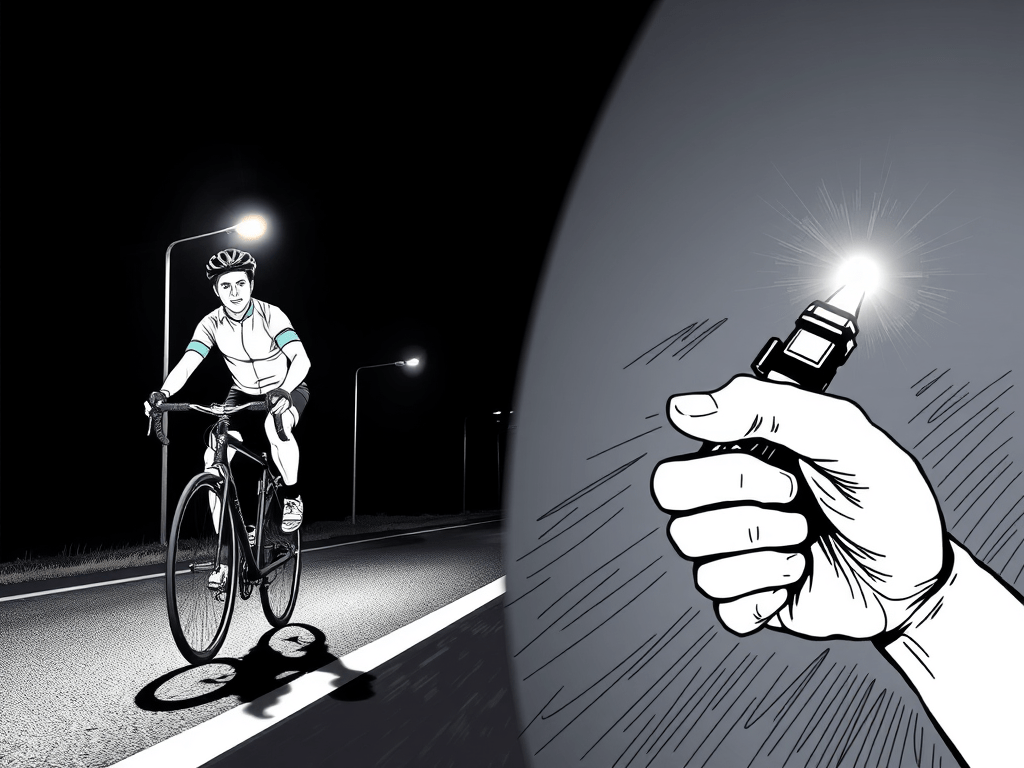
There’s a unique magic to riding when the world sleeps. The roads fall silent, the air often cools, and the familiar landscape transforms under the cloak of darkness. For the endurance cyclist, ultra-racer, or dedicated commuter, night riding isn’t just an occasional adventure; it’s a necessity – a way to extend training windows, conquer 24-hour challenges, or simply get where you need to go. But when the sun dips below the horizon, your most critical piece of gear isn’t your lightweight frame or aero helmet; it’s the beam of light guiding your way.
Enter the great “Lumen War.” You’ve seen them: the established, reputable lights like the Niterider Lumina 1200 Boost, a trusted workhorse in the cycling community. And then, there’s the dazzling, almost irresistible siren song from the depths of Amazon – “The NightBlaster 9000X!” or “SuperNova UltraBright 10,000 LUMENS!” splashed across a generic black cylinder, often priced at a fraction of the Niterider, maybe around $39.99. The numbers are staggering, the prices too good to be true. But are they? Is this your ticket to daylight-bright illumination on a shoestring budget, or a hazardous gamble when visibility means everything?
Here at ABC Endurance, we believe in cutting through the hype. This isn’t just a spec sheet showdown. We’re embarking on a real-world investigation to see if these budget behemoths can truly deliver on their astronomical promises, and whether the Niterider’s proven, albeit pricier, performance is the smarter investment when your safety, your ride quality, and your ability to conquer the night are truly on the line. Because good lighting isn’t just about seeing; it’s about efficient Time Management, carving out those precious early morning or late evening hours for your training. And it’s a massive boost to your Mental Game, transforming fear of the dark into focused confidence on any road or trail.
Deconstructing the Light: What Really Matters Beyond Raw Lumens?
Before we pit our contenders against each other, let’s talk about what makes a bike light truly effective. It’s a lot more complex than just one big number on a box.
- Lumens – The Full Story (Not Just the Headline):
- ANSI FL1 Standard: This is a set of voluntary guidelines that reputable manufacturers use to test and report performance specs like lumen output, beam distance, and runtime. When you see this, it means the numbers are more likely to be consistent and verifiable. Many ultra-cheap lights? They often skip this, leaving their claims unchecked.
- The “Cree XML-T6” Myth (and other generic LEDs): You’ll often see budget lights touting a specific LED chip, like the old Cree XML-T6, as if that alone guarantees brilliance. While Cree makes excellent LEDs, so do many others. More importantly, the LED is just one component. A quality driver circuit, effective heat management, and good optics are what turn a good LED into a great bike light. Without these, even a potent LED will underperform or burn out prematurely.
- Real vs. Theoretical Output: A light’s ability to sustain its brightness depends heavily on its design. Poor heat sinking means the light gets hot and the electronics dial back the power to protect the LED, leading to a dimmer beam than initially advertised. Battery quality and the efficiency of the driver circuit also play huge roles.
- The Beam is Everything: A million lumens pointed uselessly at the sky or a tiny spot 10 feet ahead won’t help you.
- Spot Beams: These concentrate light into a narrow, intense beam, great for seeing far down a fast road or trail. The downside? Tunnel vision, with poor visibility of your immediate surroundings or what’s lurking at the edge of the path.
- Flood Beams: These spread the light wide, illuminating your periphery and giving excellent contextual awareness. The trade-off is a shorter reach; you won’t see obstacles far in advance.
- Ideal Hybrid Beams: The best lights, like those from Niterider, use carefully designed reflectors and lenses to create a hybrid beam – a strong central spot for distance, combined with a well-distributed spill (or flood) to illuminate the sides of the road/trail and closer obstacles. This gives you the best of both worlds.
- Battery Life – The Endurance Test: For long rides, this is paramount.
- Claimed vs. Actual Runtimes: A light might claim “10 hours!” but is that on its brightest setting or a barely-visible eco-flash mode? Crucially, does it maintain a usable brightness for that entire claimed period (regulated output), or does it start bright and fade rapidly?
- Impact of Different Modes: Boost modes are great for short bursts of maximum visibility but drain batteries quickly. High, Medium, and Low settings offer a trade-off between brightness and runtime. Smart flash patterns can offer excellent daytime visibility without massive battery drain.
- Charging and Battery Health: Is it Micro-USB or the more modern, robust USB-C? How long does it take to charge? Most integrated lights don’t have user-replaceable batteries, so the overall battery lifespan and charging cycles become important for long-term value.
- Built to Last? Mounting & Durability:
- Mount Security: A light is useless if it flies off on the first bump or constantly droops. A secure, easy-to-use mount that fits various handlebar diameters and stays put is essential. Tool-free is a bonus.
- Weatherproofing (IP Ratings): IPX4 might resist splashes, while IPX6 or IPX7 can handle heavy rain or even brief immersion. For all-weather endurance riding, look for at least IPX6.
- Construction Quality: Anodized aluminum bodies dissipate heat better and are more durable than cheap plastic. Quality seals and lens materials also contribute to longevity.
- Price vs. True Value: The initial sticker price is only part of the equation. A cheap light that fails prematurely, underdelivers on brightness, or has a short battery life isn’t a bargain if it compromises your safety or needs frequent replacement.
The Contenders: A Closer Look
Let’s formally introduce our combatants:
- The Standard Bearer: Niterider Lumina 1200 Boost
- Manufacturer’s Specs: Typically offers around 1200 lumens on “Boost,” with high (e.g., 800-1000lm), medium (e.g., 400-500lm), and low settings, plus flash modes. Battery is usually a Li-Ion rechargeable. Stated runtimes might be ~1.5-2 hours on high, 4-6 hours on medium. Features a custom-engineered reflector for a hybrid beam. Often IP67 rated (dust and water-resistant). Comes with a robust, quick-release handlebar mount.
- Brand Pedigree: Niterider has been a respected name in cycling lighting for decades, known for quality, reliable performance, and good customer support/warranty.
- Current Price: Approximately $80-$100.
- The Budget Challenger: “The NightBlaster 9000X” (Our Composite Amazon Archetype)
- Advertised Specs: Lumen claims are often astronomical (5000, 9000, even 15000+ lumens). Battery details can be vague (“high capacity rechargeable”) with unrealistic runtime claims. Beam descriptions are usually generic (“super bright,” “wide angle”). IP ratings, if mentioned, are often basic (e.g., “water-resistant”). Mounts are typically simple, often a rubber strap or basic plastic clamp.
- The Anonymous Seller: Usually sold under various generic brand names by third-party sellers. Warranty and support are often minimal or non-existent.
- The Tempting Price: Ranges from $25-$45.
The Head-to-Head: Real-World Testing Scenarios
We took these two archetypes out of the box and into our (figurative) lab and onto the dark roads to see how they really stack up.
- Truth in Lumens (The “Lux Meter” Test):
- In a darkened room, we set up a lux meter at a fixed distance to measure the actual light intensity.
- Niterider Lumina 1200 Boost: On its Boost setting, the Niterider pumped out a powerful beam that measured very close to its 1200-lumen claim. On High, it delivered a strong, consistent output that was genuinely impressive and highly usable.
- “Amazon Special” NightBlaster 9000X: The initial flash when turned to “High” was indeed bright, but our lux meter told a different story. The actual sustained output was nowhere near the advertised 9000 lumens – in fact, it struggled to match the Niterider’s medium setting after a few minutes. We observed a significant drop-off in measured brightness within the first 10-15 minutes as heat likely became an issue.
- Beam Pattern Analysis (The “White Wall” & “Dark Road” Test):
- First, we shone the lights against a white wall to analyze the beam shape, then took them out on an unlit stretch of road.
- Niterider Lumina 1200 Boost: The Niterider produced a beautifully engineered beam: a potent, well-defined central hotspot that threw light far down the road, coupled with a surprisingly generous and even spill to the sides. This illuminated the road edges, overhanging branches, and gave excellent context without harsh transitions or dark spots. It inspired confidence.
- “Amazon Special” NightBlaster 9000X: This was a mixed bag of mediocrity. The beam was often characterized by an intensely bright, but very narrow, central spot (creating that tunnel vision effect), with very little useful peripheral light. Alternatively, some budget lights offer a wide but dim and uneven flood. We often noticed a distinct blueish or inconsistent color tint, which can be fatiguing on the eyes over time.
- Battery Endurance (The “Runtime Till Dim/Dead” Test):
- We fully charged both units and ran them on their highest sustainable settings, timing how long they lasted.
- Niterider Lumina 1200 Boost: On its standard High setting (around 800-1000 lumens), the Lumina ran for a solid 1 hour and 45 minutes with remarkably consistent brightness before gracefully stepping down to a still-usable medium mode, giving us plenty of warning and another 2+ hours of runtime.
- “Amazon Special” NightBlaster 9000X: This was disappointing, if predictable. Brightness on its “High” (which was already much dimmer than the Niterider’s High) visibly diminished after just 30 minutes. The light then flickered and died unexpectedly at 1 hour and 10 minutes. This unreliability is a serious concern for any ride longer than a quick jaunt.
- Mounting Stability & Durability (The “Bumpy Road” & “Weather” Test):
- We subjected both to a simulated bumpy ride and a “rain shower” (a garden hose spray).
- Niterider Lumina 1200 Boost: The robust, tool-free Niterider mount clamped onto the handlebars securely and didn’t budge an inch, even over rough patches. The unit felt solid and well-sealed, easily shrugging off our simulated downpour.
- “Amazon Special” NightBlaster 9000X: The typical generic rubber strap or flimsy plastic clamp mount felt precarious from the start. It was prone to vibrating and slipping, requiring frequent readjustment. The seals looked basic, and while it survived a light spray, we wouldn’t trust it in a proper rainstorm.
- Heat Management:
- Niterider Lumina 1200 Boost: Got warm to the touch, as expected for a high-output light, but the aluminum casing seemed to dissipate heat effectively, allowing it to maintain brightness.
- “Amazon Special” NightBlaster 9000X: Became surprisingly hot very quickly, especially near the LED. This excessive heat likely contributed to the rapid dimming as the internal electronics presumably throttled power to prevent damage.
The Verdict: Illuminating the Path to Safety and Real Value
After putting these lights through their paces, the performance gap was not just noticeable; it was a chasm.
- Niterider Lumina 1200 Boost:
- Pros: Delivers on its lumen promises with a high-quality, usable beam. Battery life is reliable and runtimes are accurately stated for its sustained outputs. Construction is robust, the mount is secure, and it’s backed by a reputable brand with a warranty.
- Cons: The initial purchase price is significantly higher than budget alternatives.
- Ideal For: Serious endurance cyclists, ultra-racers, dedicated night riders, and daily commuters who depend on their lights for safety and performance in all conditions. This is for riders who understand that good lighting is an investment.
- The “Amazon Special” NightBlaster 9000X (and its kin):
- Pros: The undeniably low initial cost is its primary (and often only) selling point.
- Cons: Lumen claims are grossly exaggerated and misleading. Beam patterns are typically poor and inefficient. Battery life is often short, unpredictable, and lacks regulated output. Durability and mount quality are questionable. Lack of meaningful warranty or support. This all adds up to a potential safety hazard.
- Ideal For: This is tough. Perhaps as an absolute last-resort emergency backup for very short trips in already well-lit urban areas. Or maybe for tasks off the bike where high performance isn’t critical. For any serious cycling, especially at night or in endurance settings, it’s a risky proposition.
- The Safety Equation: This is where the decision becomes crystal clear for endurance cyclists. When you’re miles from anywhere, in the dead of night, or navigating tricky descents in fading light, your light isn’t just an accessory – it’s a lifeline. Can you truly afford for it to underperform, dim unexpectedly, or simply die on you? The answer, for anyone who values their safety, is a resounding no.
Conclusion: Don’t Be Dazzled by Deceptive Deals – Invest in Your Vision
While the allure of saving a few bucks is understandable, the world of high-output bike lights is one where you often get what you pay for. Investing in a quality light from a reputable brand like Niterider isn’t just buying brightness; it’s buying reliability, well-engineered optics, dependable battery performance, robust construction, and ultimately, peace of mind.
The long-term value derived from a light that performs consistently, lasts for years, and keeps you safe far outweighs the fleeting satisfaction of a cheap initial purchase that may quickly lead to disappointment or, worse, a dangerous situation. When the sun sets and your adventure continues, make sure you have a light you can trust to illuminate your path, every single time.
What are your bike light horror stories or shining successes? Have you found a budget light that genuinely surprised you with its performance, or have you learned the hard way about investing in quality? Share your experiences and recommendations in the comments below!
Discover more from ABC Endurance
Subscribe to get the latest posts sent to your email.
