

High school biology class was not particularly interesting. The topics covered, while not interesting to the average tenth grader, are extremely pertinent to endurance athletes. Endurance sport, for the individual, comes down to the capacity of the body to convert the molecules in food into specific forms of movement.
Knowing a bit of physiology and biology can help athletes to perform better; understanding the reasons behind why we feel fatigue helps us understand and respond effectively. A great place to start is with nutrition.
A quick note on units of measurement. A calorie is the specific amount of energy needed to increase the temperature of 1 gram of water by 1 degree celsius. This amount of energy really isn’t sufficient when describing nutrition and exercise. Instead, the typical unit of measurement is the kilo-calorie, of kcal. This is the amount of energy needed to increase the temperature of 1000g or 1 liter of water by 1 degree celsius. The “Calorie” on food labels is a kilo-calorie. For the remainder of this article, I will use a capitalized “Calorie” to refer to a kilo-calorie.
There are three types of molecules that make up the majority of the energy in the food that we consume. Those three groups are:
- Protein
- Carbohydrates
- Lipids (Fats)
There is only one molecule which can produce activity for exercise, a molecule within the cells of the body. This molecule is Adenosine Triphosphate (ATP). ATP is the fuel of all cells in the body, but there is a shocking little amount of it within each cell. At a full sprint, the energy in muscles stored ATP would be exhausted in seconds, into its lower energy form ADP. Metabolism of the body is the process by which energy is facilitated and converted from the food that we eat into ATP. There are a variety of pathways this energy can flow, and when viewed globally, it looks too complicated to be actionable. Wikipedia has a metabolic pathway graphic stylized as a metro-map:
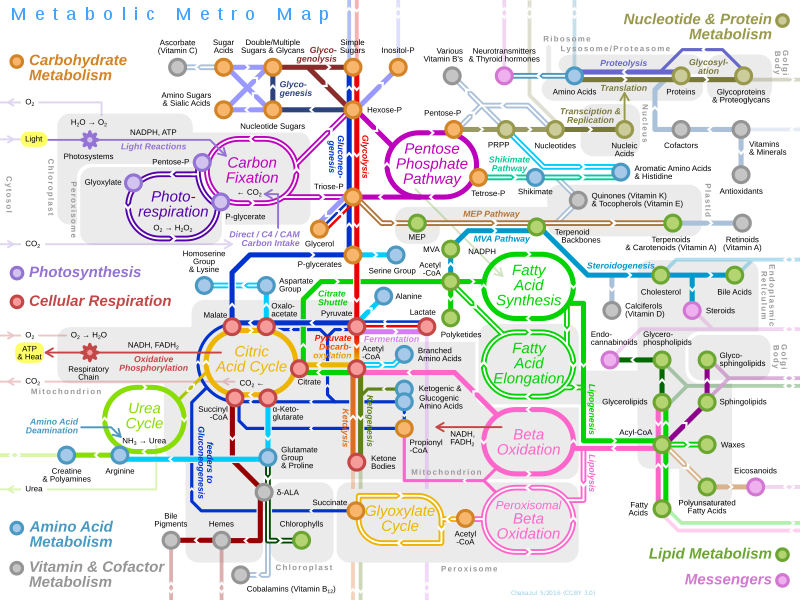
ATP and Heat are noted on the left side, middle of the chart, and are the main outcome of all this activity. Of the three major calorie sources, each is noted on this metro map. Carbohydrates are noted at the top, the blue and red lines entering the Metro. Lipids enter on the bottom right, with the green and pink lines. Proteins are noted on the bottom left, with the green line.
Improving your performance as an endurance athlete is largely about improving the flow of energy through this system. Training should seek to match the types of nutrition and energy that your goals require, such that the specific pathways that you will use on race day improve. Optimizing nutrition, practicing the specific intensity and type of exercise which will be critical on race day; if you’d like assistance in optimizing your training towards your goals, reach out to me at brycoward@gmail.com.
Discover more from ABC Endurance
Subscribe to get the latest posts sent to your email.

One thought on “Metabolism for Endurance Athletes, Part 1”