

The half marathon is a great distance for the recreational runner. The race takes about 2 hours, and doing any sort of exercise for two full hours without a break is an achievement for most people. The race has the added benefit of being a distance which one can train remarkably well while working; training for eight to ten hours a week can yield fantastic results on race day. For these reasons, in addition to the fact that several people close to me are doing the same race, I’m racing the Outer Banks Half Marathon in November. The race is six weeks away, and I’m glad to report my training is going well.
Here’s a breakdown of my training plan for the half marathon:
Background: I achieved a PR at this course last year. The training season is perfect, with the race coming in the second week of November. There’s still enough light to train outside, and in North Carolina, the temperature on race day is somewhere around 55F. The course is a bit winding, but pancake flat with a short hill at mile 10. It’s the perfect course to achieve a personal record.
Last year, my pace was 6:30/mile and the race looked like:
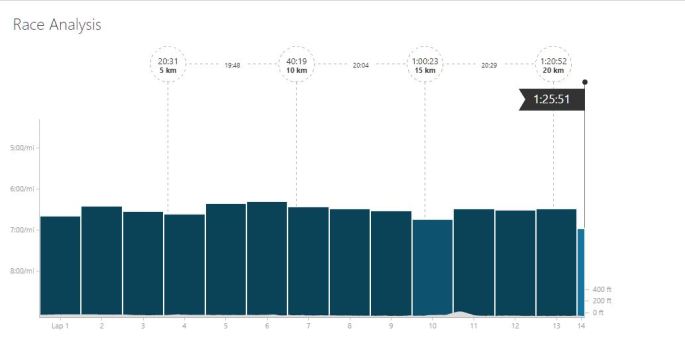
The race is remarkably smooth. My effort was nearly full gas, for the duration of the race. My pacing was good that day, although I did not have much to give towards the end of the race, as evidenced by the significant slow down at the one hill at mile 10.
Race: Outer Banks Southern Fried Half Marathon; 13.1 miles, 100 feet of elevation gain
Goal: Last year, I ran a PR of 1:24:56. My goal this year is to run sub 1:20.
Notes: I broke my collarbone about 6 weeks prior to starting training. I lost a ton of fitness (although I didn’t have a ton of run fitness to begin with), and gained some weight. I planned a training schedule 9 weeks from the race.
| Week Number | Mileage Goal | Focus |
| 1 | 30 | Learning to run again |
| 2 | 35 | Building Running Habits |
| 3 | 25 | Recover |
| 4 | 32.5 | Running efficiency |
| 5 | 37.5 | Running efficiency and Intervals |
| 6 | 25 | Rest |
| 7 | 35 | Race Pace and Intervals |
| 8 | 30 | Race Pace and Efficiency |
| 9 | 25 | Taper and Race |
Weeks 1 through 3 I concentrated on learning the habit of running again. I focused on getting enough sleep, on eating healthier, as well as getting out the door five or six days a week. So much of training is based on running regularly, and in the later weeks, getting out the door must be automatic; if it’s a question mark as to whether you are going to run today, and you have a hard workout, it’s not going to happen. By focusing on finding a training groove early, you can build fitness and the mental toughness to train regularly in later weeks. Note that I did not much focus on speed during these three weeks. The point is to *go run* regularly and get the needed training volume in miles, not to run specific workouts.
I’m in week 4 now, and I’ve gotten to the track and done one tempo run. There are two types of runs I am doing now; the first is training runs. Training runs over this three week period should be focused on a specific goal, and be difficult to complete. As fitness builds, I hope to make big gains and start getting closer to my goal (6:00/ mile pace for long runs). The second type of run is recovery runs. If it’s not a training run, it’s a recovery run. Recovery runs are slow and easy. I try to just run easy but how I feel. If I’m breathing hard, it’s probably too hard. The point is to leave gas in the tank to focus on drilling the training runs.
The final three weeks will be focusing on increasing speed. In week 7, the goal will be to run the most (in terms of mileage), all fairly fast during my training. In week 8 and 9, I’ll pull back the mileage while maintaining fast, hard, short workouts. Hopefully, the training will culminate in continuous improvement until race day.
I have not completed this short of a training plan before, but I have a lot of confidence in the model. Breaking training up into blocks, with hard training for a period and then some rest to recover, is a concept called periodization, and it’s a proven way to achieve high levels of fitness while preventing the risk of injury. If you came here looking for a training plan for half marathon, take a look at the table above, and work backwards from your race. Give yourself a few weeks to get to the point that you can run 30 miles prior to the start of your training, and give it a go. I’d bet 9 weeks of solid planned training is enough to get most people a PR.
Discover more from ABC Endurance
Subscribe to get the latest posts sent to your email.
